Rewritten Elder-Care AI Draft (Inverted Pyramid with Proof & Evaluation)
28/4/2026
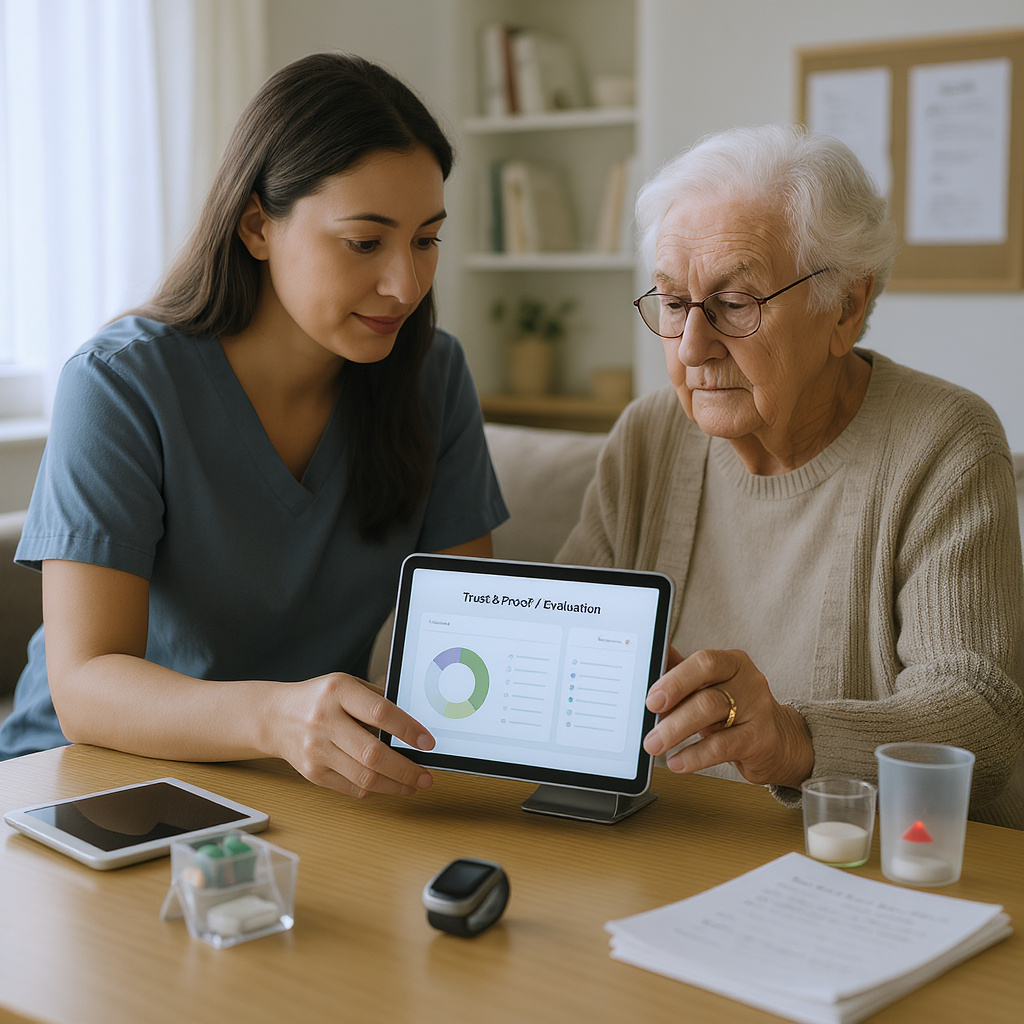
Main point: Good elder-care AI works like decision support. It helps families act faster with less guesswork—without replacing human care—and it proves safety through measurable outcomes and an end-to-end escalation workflow.
TL;DR
- Safety + daily coordination first: detect meaningful changes, prompt clear next steps, and escalate when stakes are high.
- Trust requires proof: verify false alarms, confirmation/escalation timing, and caregiver usefulness in real workflows.
- Measure end-to-end impact: track false alarms, on-time confirmations, and shift-report comprehension—not just model accuracy.
Why this matters (the core problem AI should solve): Families face repeated “small” risks that add up over time—falls, missed medication, loneliness, and caregiver admin load. AI is valuable when it reduces those risks day-to-day.
What “good” looks like in practice (main benefits):
- Safety: pattern-based alerts (not constant noise) with context and a clear response plan.
- Comfort: prompts that reduce friction (lighting, temperature guidance, simple voice instructions).
- Routine: medication, hydration, meals, and appointment reminders that fit the person’s real schedule.
- Care coordination: summaries, pending task tracking, and shift-ready handoff reports that cut the admin tax.
Where AI should fit (key arguments):
- Detecting patterns: noticing changes in mobility or activity that could signal risk early.
- Prompting actions: guiding the next step in plain language (confirm, re-check, or escalate).
- Reducing manual admin work: turning scattered messages into a usable timeline for caregivers.
Important boundary (what AI is not): It should not “decide medical outcomes.” For borderline signals, the workflow should guide re-check + context. For high-risk situations, it must escalate to humans/clinicians using a tiered ladder.
Trust & Proof: what to require before you buy
- Data minimization: collect only what’s needed for the specific care goal.
- Consent + transparency: plain-language settings that show what data is collected and when alerts trigger.
- Security basics: encryption, role-based access, audit logs, and retention/deletion rules.
Three high-impact use cases to evaluate (with proof checklists)
1) Falls & “no activity” safety alerts
- Measure in your pilot: false-alarm rate, time-to-response, and action success after confirmation.
- Example: “No usual activity since 9:10 AM. Would you like a quick check-in call now?”
- Trust & Proof checklist:
- Accuracy claim: ask for real home/longitudinal false-alarm behavior (not just lab sensitivity).
- Context claim: confirm how context reduces alert fatigue without increasing misses.
- Workflow claim: verify offline/backup behavior and escalation timing.
2) Medication reminders with confirmation
- Measure in your pilot: on-time dose confirmation rate, reminder engagement, and discrepancy rate vs. caregiver logs.
- Example: “Evening tablet time. Take with water.” Person confirms; if not, caregiver gets a clear next-step prompt.
- Trust & Proof checklist:
- Adherence claim: look for evidence that reminders change outcomes with a real workflow (timing + verification).
- Confirmation claim: ask how “taken vs. not taken” errors are handled (including accidental taps).
- Usability claim: verify comprehension (especially hearing/vision needs) and prompt customization.
3) Caregiver coordination that reduces admin load
- Measure in your pilot: shift-report comprehension, admin time saved, and pending task closure rate.
- Example: A short “since last report” timeline plus an explicit pending list and escalation triggers.
- Trust & Proof checklist:
- Summaries claim: confirm reports preserve a clear timeline from auditable event logs.
- Usability claim: ensure caregivers can drill into the “why” when needed.
- Escalation claim: test with a staged drill (what happens when confirmation is missing?).
Top 3 next actions
- Pick 2–3 measurable outcomes for your pilot (e.g., false-alarm rate, on-time confirmations, and shift-report comprehension).
- Run response drills for: (1) an unconfirmed medication dose, and (2) an alert with no caregiver reply—then verify escalation timing.
- Ask for proof artifacts: anonymized pilot metrics and sample shift reports tied to event timelines.
Key caution: Avoid “black box” systems. If you can’t explain the alert/reminder trigger in plain language, or if escalation/escalation timing isn’t testable end-to-end, it will likely create stress instead of support.