Predictive Analytics That Teams Can Act On (Inverted Pyramid Rewrite)
18/5/2026
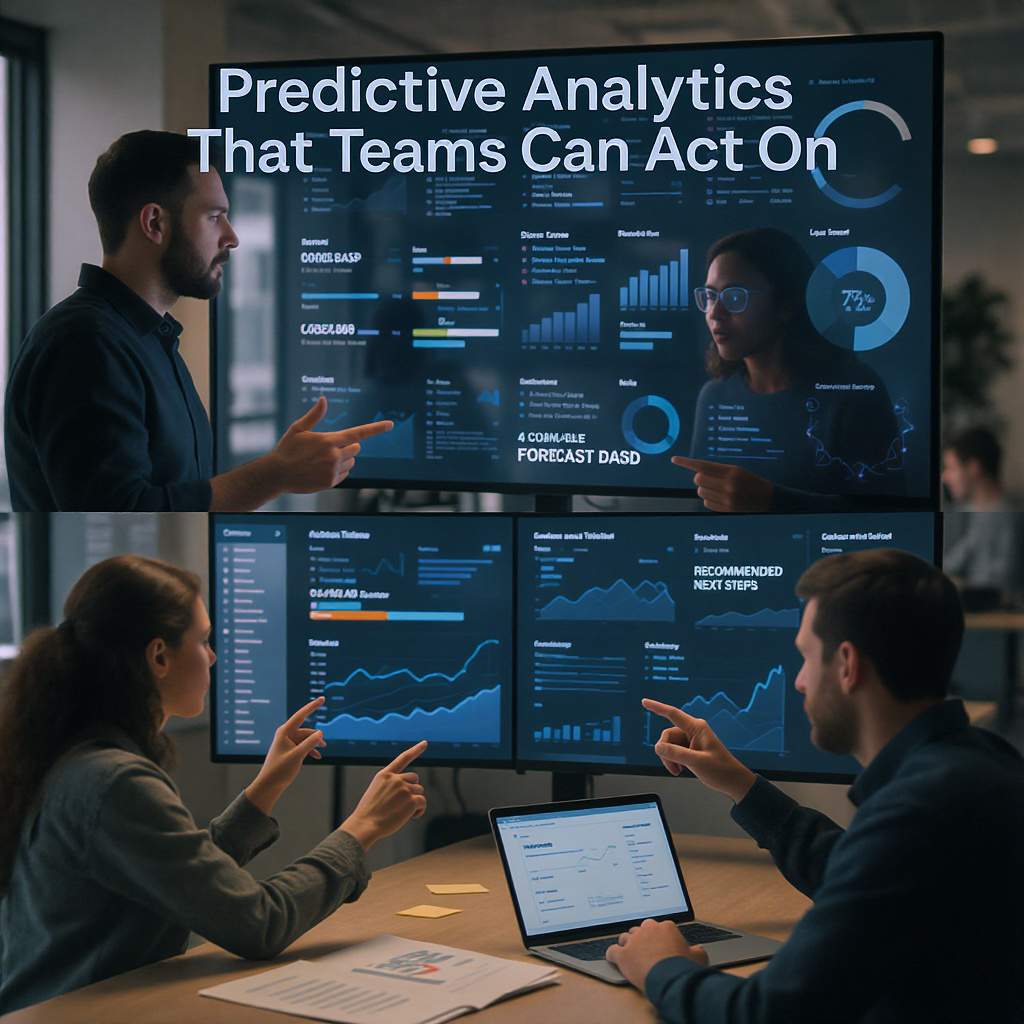
Predictive analytics is a practical way to turn historical data into trustworthy forecasts you can act on. It estimates what’s likely to happen next and expresses that likelihood as probabilities—so teams can respond earlier, prioritize better, and measure improvement.
Prediction answers “what’s next?” Explanation answers “why it might happen?” When teams understand both, predictions become decision tools instead of charts.
Why this matters (the top benefits):
- Fewer surprises: detect risk early and prepare before problems escalate.
- Faster decisions: align stakeholders around measurable forecasts and confidence.
- Better planning: adjust staffing, inventory, budgets, and workflows to expected outcomes.
Where predictive analytics delivers leverage (key arguments):
- Sales & marketing: lead scoring, churn prediction, and next-best action signals that estimate both likelihood and which intervention tends to work.
- Operations & supply chain: delay risk detection and inventory optimization that account for uncertainty (not just averages).
- Finance & risk: credit risk scoring, fraud detection, and early warning systems for defaults.
- Healthcare & life sciences: readmission risk and deterioration alerts, paired with careful validation and privacy controls.
- Customer support: escalation prediction, resolution-time forecasting, and ticket routing to prioritize the right cases sooner.
What to build first (middle: the practical build path):
Step 1: Define the outcome and success metric. Choose a specific target (and time horizon) and define what “better” means—precision/recall, error reduction (MAE/RMSE), calibration quality, or backtesting performance.
Step 2: Collect and prepare data. Clean records, standardize timestamps, handle missing values, verify label accuracy, and run leakage checks so the model isn’t “seeing the future.” Data quality is foundational—not optional.
Step 3: Train and validate. Use validation strategies that mirror real use (holdout sets and, when needed, cross-validation). Prevent overfitting and tune using validation data only. For time-dependent problems, evaluate with backtesting.
Step 4: Deploy into a workflow. Predictions create value when they trigger actions: dashboards, APIs, and alerts plus clear decision rules based on probabilities (e.g., auto-action above a confidence threshold; otherwise route to review).
Step 5: Monitor in production. Track drift (input pattern changes), performance decay (metric degradation), and segment-level reliability. Define retraining or recalibration triggers ahead of time, and store versions so you can reproduce outcomes.
How to evaluate what “good” really means (middle: decision-aligned metrics):
- Classification: precision/recall better reflect cost trade-offs than accuracy alone.
- Regression: MAE and RMSE quantify real error in the same units as the target.
- Time series: backtesting validates usefulness across time, seasons, and shifting conditions.
How to earn trust (middle: interpretability, fairness, privacy):
- Interpretability: identify key drivers (feature importance), show how predictions change with inputs (partial dependence), and provide per-case explanations (SHAP-style feature attributions).
- Fairness checks: monitor group-level performance gaps and audit features/data for proxies or measurement differences.
- Privacy basics: minimize data, enforce access controls, follow applicable regulations, and strengthen governance (dataset versioning, lineage, auditability).
Useful examples and extra tips (bottom: quick “start here” guidance):
- Start small: pick one high-impact target with clear labels and measurable consequences (e.g., “Will a ticket exceed SLA within 2 hours?”).
- Baseline first: compare against a simple heuristic or rule-based approach before chasing complex models.
- Set decision owners: align business leadership, data science, and engineering on actions, thresholds, and success metrics.
- Design feedback loops: measure what happens after interventions so the system improves with real outcomes, not just offline scores.
- Ground your practices in trustworthy guidance: align lifecycle evaluation and monitoring with recognized frameworks such as NIST AI guidance.
Bottom line: Build forecasting systems that stay dependable over time—by using the right signals, validating properly, integrating predictions into decisions, and continuously monitoring drift and performance.