Responsible Voice Cloning — Practical Guide (Inverted Pyramid)
8/12/2025
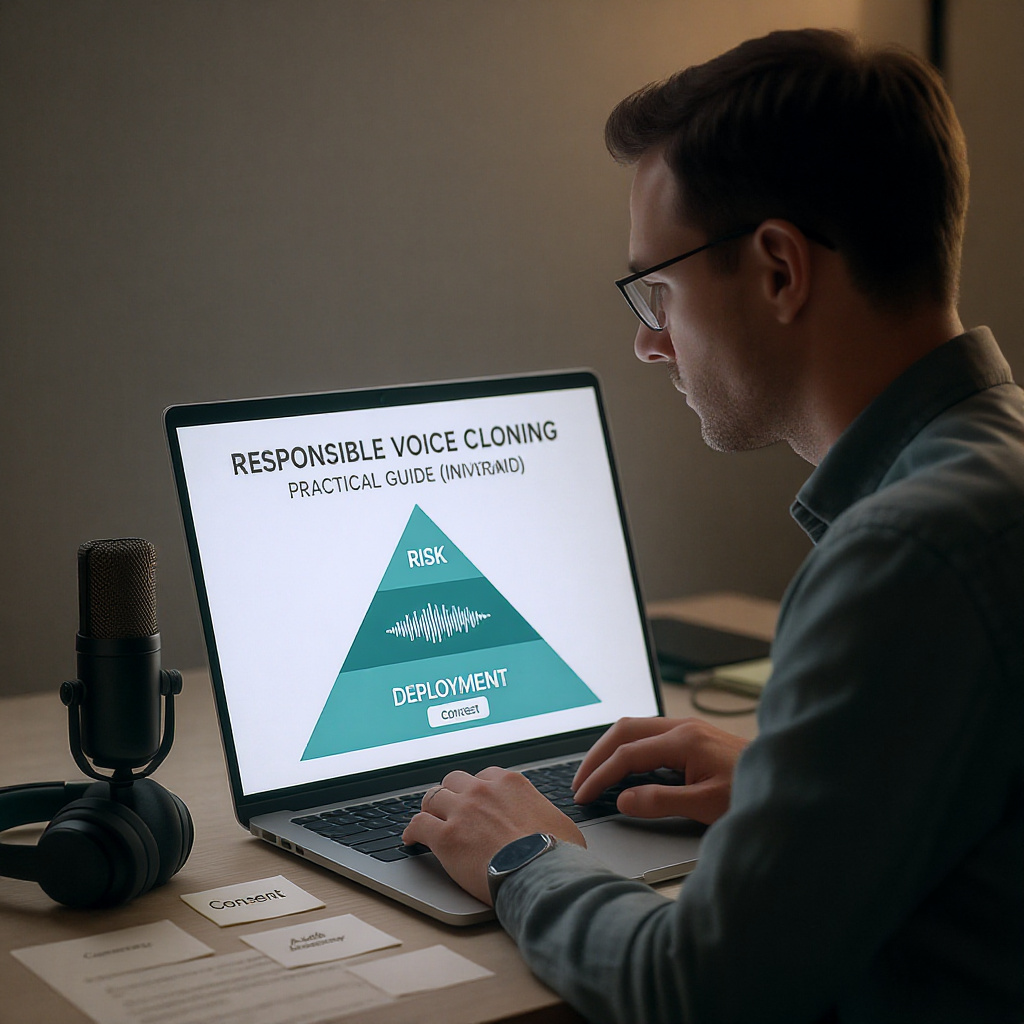
Main point: Voice cloning can deliver tangible benefits—accessibility, consistent brand voices and operational efficiency—if deployed with clear consent, provenance, technical safeguards (watermarking, monitoring) and measurable pilots.
Key benefits and evidence:
- Accessibility: Restore a loved one’s voice or give assistive devices a familiar tone to improve communication.
- Personalization & brand: Consistent, multilingual voices for IVR and virtual assistants strengthen identity and clarity.
- Media & efficiency: Faster ADR, localization and narration with fewer re‑recordings and quicker iteration.
Core technical elements (what matters):
- Data: Clean recordings + accurate transcripts. 2–5 minutes yield a recognizable clone; 10–30 minutes across varied sentences/emotions gives reliable expressiveness.
- Model & pipeline: Typical flow — collect → preprocess → train/adapt → synthesize → evaluate. Use transfer learning and speaker embeddings for adaptation with limited data.
- Vocoder: Chooses fidelity vs latency: high‑fidelity for studio, lightweight/streaming for interactive use.
Operational trade‑offs & mitigations:
- Latency targets for assistants (~200–300 ms) may require smaller models, quantization, pruning or edge inference.
- Cross‑lingual cloning often produces accenting; use phoneme representations and target‑language fine‑tuning to improve results.
Safety, consent & governance:
- Obtain explicit, auditable consent specifying permitted uses, retention and revocation; store metadata with recordings.
- Clarify IP in contracts: ownership of raw recordings vs trained models vs synthesized outputs.
- Embed provenance and imperceptible watermarking; add authentication, anomaly detection and takedown workflows to limit misuse.
How to start (practical steps):
- Pick one narrow pilot (single IVR prompt or short narration). Define metrics (task completion, user preference, error rate) and run A/B tests.
- Use public datasets for benchmarking (VCTK, LibriSpeech, Common Voice) before donor data.
- Combine objective measures with perceptual tests and security checks (watermark detection, playback anomaly monitoring).
Background & resources: Modern toolkits and research (DeepMind, Google Research, NVIDIA, Hugging Face, ESPnet, Coqui) provide reproducible examples. Choose vocoder and adaptation methods based on fidelity, compute and latency needs. Keep legal counsel involved for biometric/privacy rules.
Extra tips: Document every consent interaction, attach provenance metadata to models, make revocation simple, and layer automated detectors with human review. Start small, measure, then scale with governance in place.